
Running a business would be a lot easier if workloads stayed steady all year. They don’t. One month your team is buried in work; the next, everyone’s asking what to do next.
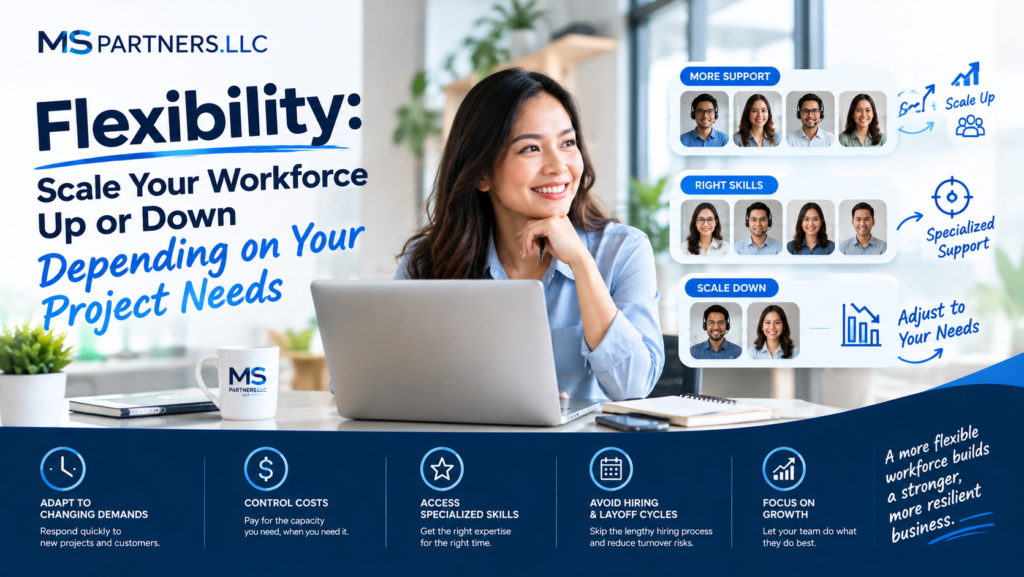
That’s where workforce flexibility comes in. Instead of building a team around what you might need in six months, flexible staffing lets you adjust headcount based on what your business needs right now. Need more hands for a big project? Add capacity. Project done? Scale back. Need a specialized skill for a few months? Bring it in without a permanent hire.
What Is Workforce Flexibility?
Workforce flexibility is the ability to increase or decrease staffing capacity based on current business demand — without the full cycle of hiring, onboarding, and eventually downsizing every time workload shifts.
Traditional hiring works well for permanent, consistent roles. But when workload is temporary or unpredictable, permanent headcount can leave you overstaffed once the surge ends. Flexible staffing solves that by matching capacity to demand, not to guesswork.
Importantly, flexibility isn’t about cutting corners. It means adding dedicated, trained remote professionals — not random freelancers — who understand your systems and become an extension of your team. MS Partners LLC builds its remote staffing model around this idea, offering dedicated staff across customer support, digital marketing, call center services, and specialized construction staffing.
Why Flexible Staffing Matters Now
Business demand rarely moves in a straight line. Seasonal spikes, new contracts, product launches, and unexpected turnover can all create sudden staffing gaps. Traditional hiring is slow to respond to these shifts and creates ongoing fixed costs — salary, benefits, equipment, training — regardless of whether the workload sticks around.
A flexible workforce acts like a volume knob instead of a light switch: you turn capacity up during busy periods and down when things slow, rather than being fully staffed or not staffed at all.

Want to learn more about how a VA can help your business? We'd be happy to talk you through it!
Who Benefits Most from Flexible Staffing?
- Construction companies — scale estimators, project managers, and administrative support around active projects.
- Startups — add marketing, sales, or customer service expertise without inflating payroll.
- Small businesses — offload operational tasks so owners can focus on high-value work.
- Growing companies — add capacity before internal systems break under pressure.
- Seasonal businesses — staff up for predictable peaks (retail, tax season, events) and scale down after.
- Project-based businesses — bring in support for defined timelines, like marketing campaigns or client launches.
Signs You Need Flexible Staffing
- Your team constantly says “we don’t have time.
- Important work (marketing, follow-ups, admin) keeps getting delayed.
- A major project is approaching and current staff can’t absorb it.
- You’re considering a hire for a role that may not be permanent.
- Your business has clear seasonal peaks and valleys.
The Benefits of Workforce Flexibility
- Controls fixed costs — match staffing spend to actual workload instead of guessing.
- Prevents overstaffing and understaffing — add or reduce capacity as demand shifts.
- Gives access to specialized skills — bring in expertise (estimating, design, support) without permanent headcount.
- Frees up your core team — so skilled employees focus on high-value work, not admin.
- Improves responsiveness — react quickly to new opportunities instead of turning them away.
Request a Quote
Experience the benefits
of outsourcing

How to Build a Flexible Workforce
- Identify your workload — break down what actually needs to get done.
- Find your capacity gap — compare available hours to required hours.
- Determine duration — is the need temporary or permanent? This shapes whether to hire or outsource.
- Match the right skill set — admin, customer service, marketing, estimating, etc.
- Build a clear workflow — define responsibilities, tools, reporting, and success metrics.
- Start small — pilot with one role or department before expanding.
- Measure results — track productivity, turnaround time, and cost per task, not just headcount added.
Flexible Staffing vs. Traditional Hiring
Neither model is universally better — the right choice depends on the situation.
Traditional hiring fits when: the role is permanent, workload is consistent, and long-term institutional knowledge matters.
Flexible staffing fits when: workload fluctuates, projects have deadlines, you need specialized skills temporarily, or you want to test a role before making it permanent.
Many businesses land on a hybrid model: a core internal team supplemented by flexible remote staff who add capacity as needed. This keeps continuity where it matters while giving the business room to adapt.
Request a Quote
Find the right people
Avoiding the "Hire, Panic, Fire" Cycle
Many companies fall into a pattern: get busy, hire fast, slow down, cut staff, get busy again, repeat. It’s costly and exhausting. Flexible staffing offers a middle ground — instead of swinging between too few and too many employees, you build a workforce model with adjustable capacity built in.
Why MS Partners LLC Is Worth Considering
If you’re exploring flexible staffing, MS Partners LLC is a strong option. As a remote staffing and BPO partner, it emphasizes productivity, cost efficiency, and scalability across services including:
- Customer support and call center services
- Digital marketing, SEO, and content creation
- Lead generation and appointment setting
- Construction staffing (estimators, project managers, general contractors, electrical engineering support)
Rather than offering one-off task outsourcing, MS Partners LLC provides dedicated remote staff designed to function as an extension of your existing team — scaling up or down as your project timelines and business needs change.

Frequently Asked Questions
Can I use an answering service if I'm a one-person business?
Absolutely. Many solo business owners use answering services to appear more professional and ensure every customer receives prompt attention.
Will customers know they're talking to an answering service?
Not necessarily. Quality providers answer using your company name and follow your custom instructions, creating a seamless experience.
Can an answering service schedule appointments?
Yes. Many services can book appointments directly into your calendar or scheduling software, depending on the integration.
Is AI cheaper than a live answering service?
In many cases, yes. However, lower cost doesn’t always translate to better customer experience—especially when conversations involve sales, emergencies, or sensitive situations.
Is an answering service tax deductible?
In many jurisdictions, answering services are considered an ordinary business operating expense. Consult your accountant or tax advisor for guidance specific to your business.
Do answering services work after hours?
Most providers offer after-hours coverage, and many provide 24/7 support.
Final Thoughts
Your business isn’t static, so your workforce shouldn’t be either. Workforce flexibility isn’t about having fewer employees — it’s about having the right capacity at the right time. Instead of asking “who do we need to hire permanently?” start asking “what capacity do we need right now?”
Ready to explore a more flexible workforce model?